Ethernet Architecture
This section describes the Ethernet protocol layers, the Linux network device framework, and the JH-7110 Ethernet hardware architecture.
Ethernet Protocol Layers
Ethernet is a LAN technology defined by IEEE 802.3 standards, supporting data rates of 10 Mbps, 100 Mbps, and 1 Gbps. The Ethernet protocol spans two layers of the TCP/IP reference model.
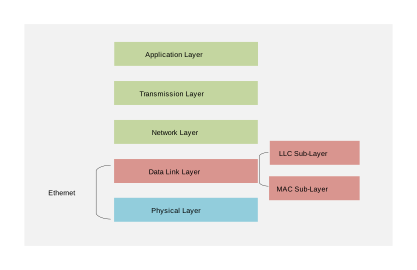
- L1 (Physical Layer): Handles bit-level transmission over the physical medium
- L2 (Data Link Layer): Provides reliable data transfer between network nodes
The L2 layer consists of two sub-layers:
- LLC (Logical Link Control) sub-layer: Handles flow control, error handling, and frame synchronization
- MAC (Media Access Control) sub-layer: Manages access to the physical transmission medium and frame
Linux Network Device Framework
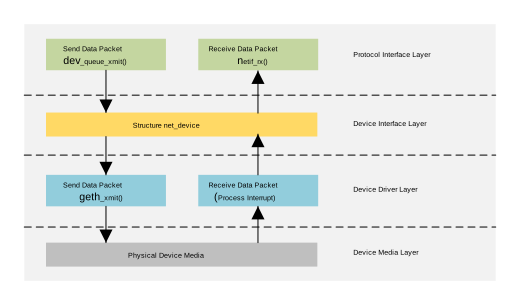
The Linux network device framework implements a four-layer architecture as follows.
| Layer | Description |
|---|---|
| Protocol Interface Layer | Provides unified data send and receive interfaces:
|
| Device Interface Layer | Provides the struct net_device abstraction,
which describes network device attributes and operations.
Devices register with the framework using
register_netdev() . |
| Device Driver Layer | Implements the functional operation pointers defined in the
structure of net_device. And then the
operations are handed over to hardware drivers for execution.
|
| Device Media Layer | Contains as the physical elements which completes the data packet sending and receiving tasks, including the network transmission adapter and the media used for transmission. |